
Les Merveilles
TWENTYTWENTY
Created in 2021
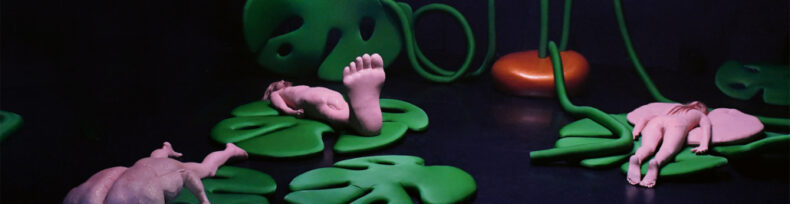
The Blemmyes, Sciapodes and Panotii are among the many fantastical peoples that haunted the medieval imagination. They are mentioned in Pliny the Elder’s Natural History, sculpted on the tympanum of Vézelay, and described by Marco Polo in his Book of Wonders, which includes an illumination depicting a Blemmye and a Sciapode in a green landscape.
For their contemporaries, these monstrous creatures were the result of a “recomposition of nature’s great puzzle”. They were omnipresent and even considered essential encounters in any account of distant travels (i.e. outside Europe and the Mediterranean basin), which had to be documented. They were referred to by the adjective mirabilis, meaning ‘surprising’, ‘strange’, something to marvel at.
Jacques Le Goff explains that in the Middle Ages, our current boundary between the real world and the imaginary world did not exist. There was another boundary: that between ‘the material real and the imaginary real’.
The imaginary real! What a beautiful concept for creating a show! And how can we not note this delightful analogy with the creation of a world on a theatre stage, so real during the performance?
After bringing multiple figures to life (shaggy yetis, Swiss santons, snowmen, a sculpture by Alberto Giacometti, a steatopygous Venus, etc.), we could not remain indifferent to these marvellous bodily transformations.
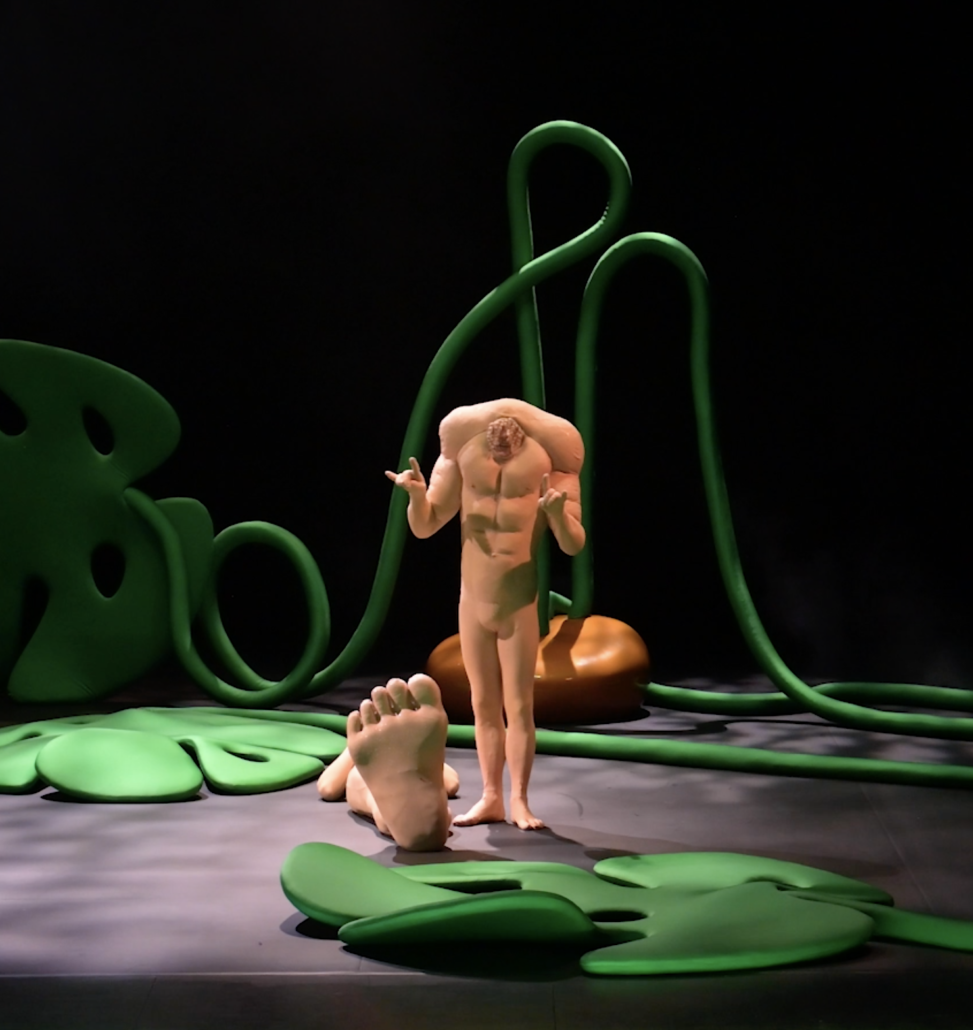
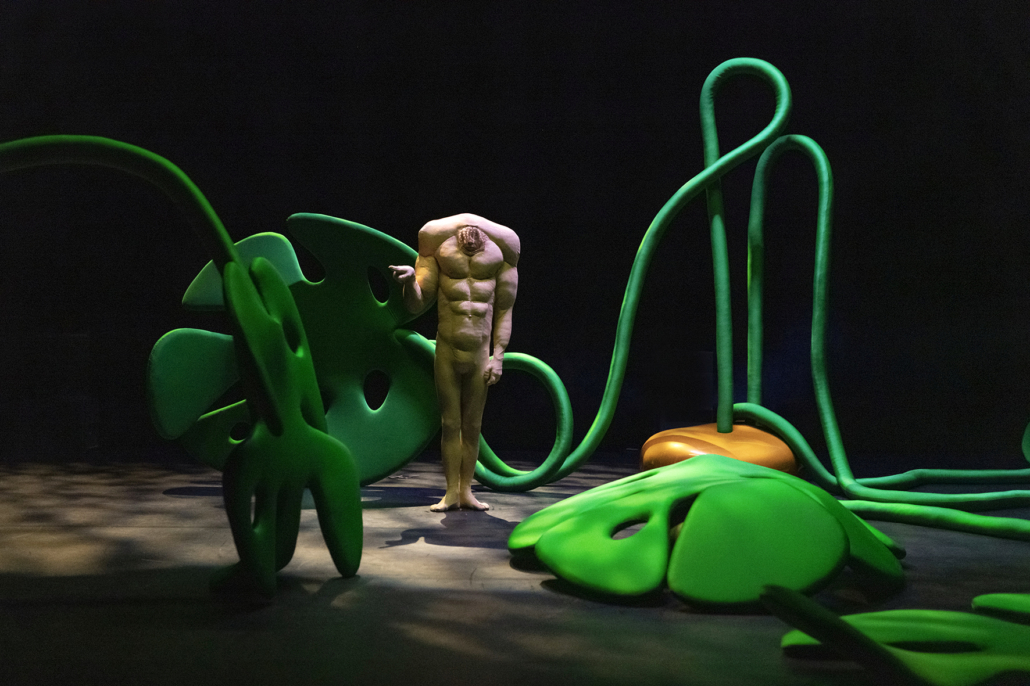
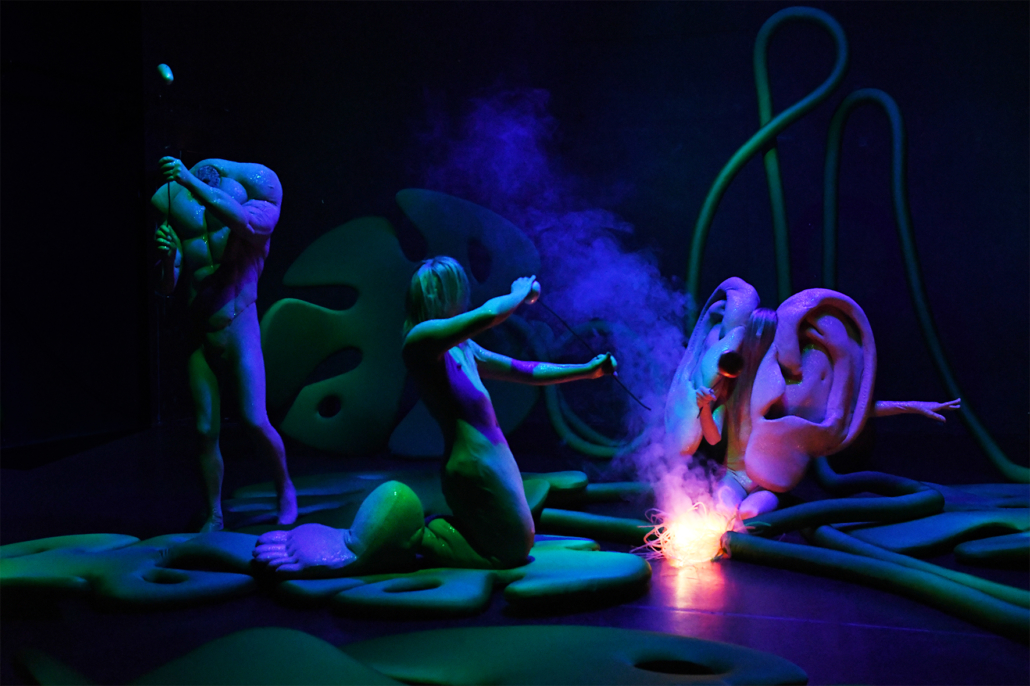
Thus, the Panotii has huge ears, the Sciapode has a single foot, and the Blemmye—who is headless—carries his face on his chest and sometimes simultaneously on his back.
The stories give these metamorphoses rather comical purposes: the Panotii wraps himself in his ears to sleep, while the Sciapode (literally “shadow foot”) uses his oversized foot as a parasol to protect himself from the sun.
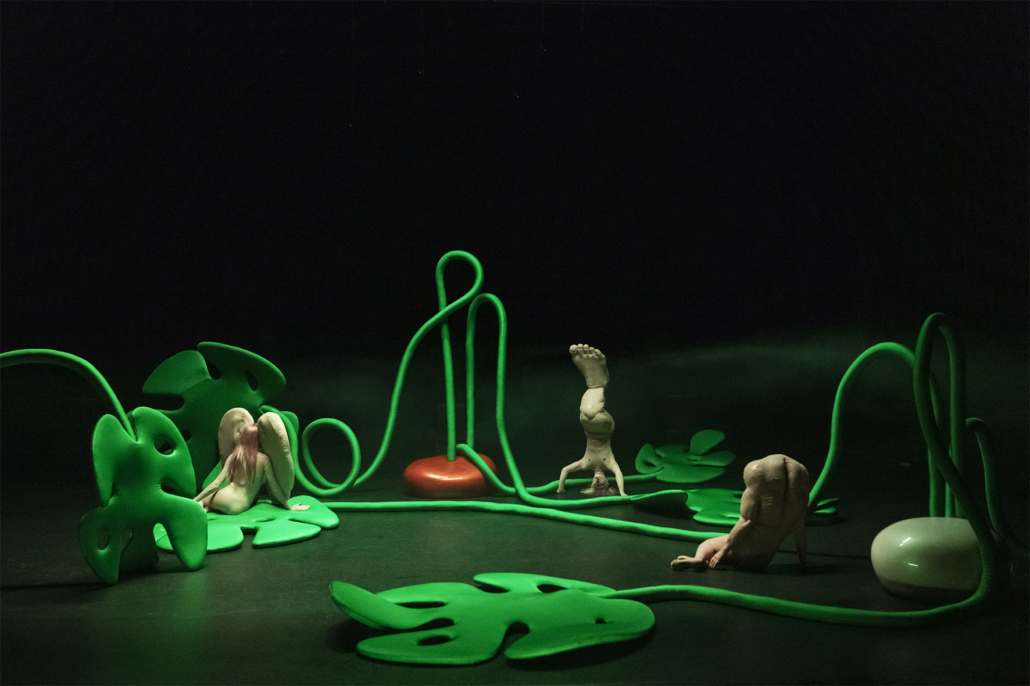
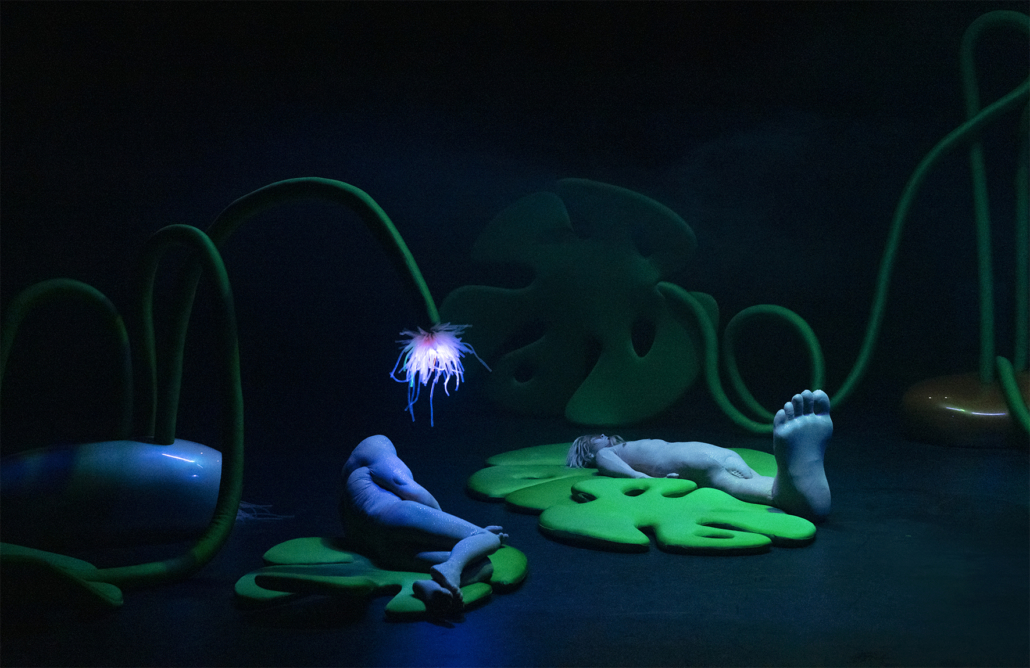
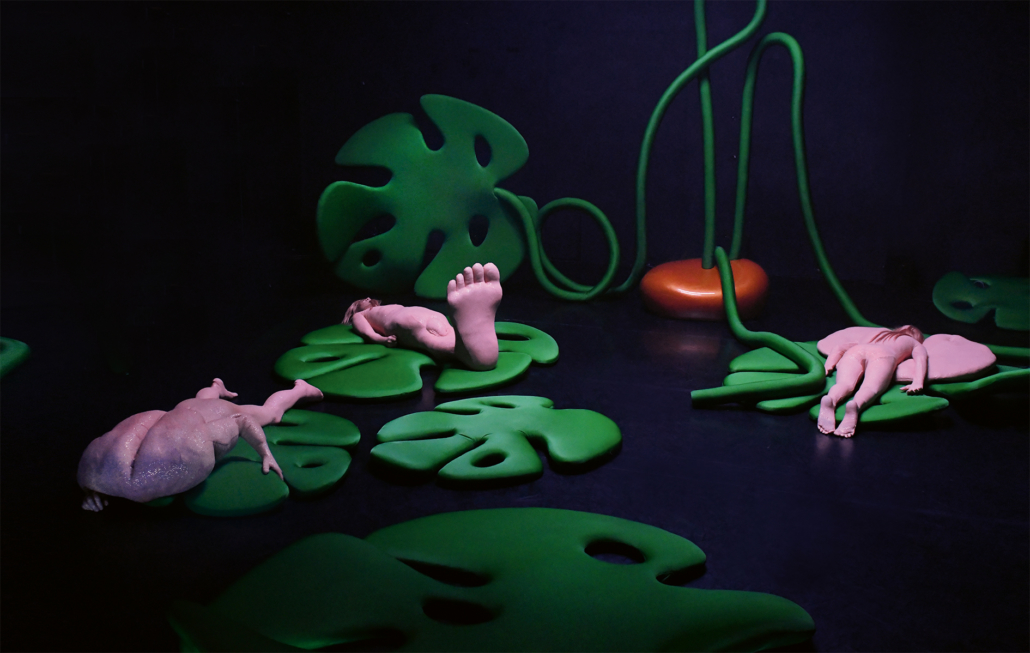
After the choreographed armour and living bushes of Bataille (2015), and the improbable assemblage of life forms in Ermitologie (2017), we now turn our attention to this small tribe with their disturbed physicalities. And to create on stage a space that, as a plastic, sculptural and sonic biotope, will be the dreamlike and poetic setting in which our imagination will be constructed, enriched by that of our illustrious medieval ancestors.
Creation 2021
Concept, choreography, set design, costumes Yvan Clédat & Coco Petitpierre
With Sylvain Prunenec, Sylvain Riéjou, Erwan Ha kyoon Larcher alternating with Max Ricat
Sound design Stéphane Veccchione
Lighting design Yan Godat
Interface development Yan Godat and Stéphane Vecchione
Textile production assistant Anne Tesson
Administration, distribution Clémence Huckel and Iris Cottu – Les Indépendances
Texts: based on Empedocles, Ovid, Pliny the Elder, Jean de Mandeville, etc.
Production Lebeau et associés
With the support of the Fondation d’entreprise Hermès as part of its New Settings programme.
Co-production La Villette, Paris, La Halle aux grains, Scène nationale de Blois, Les Subsistances, Laboratoire de création artistique, Lyon.
With the support of the DRAC Ile-de-France for project assistance.